
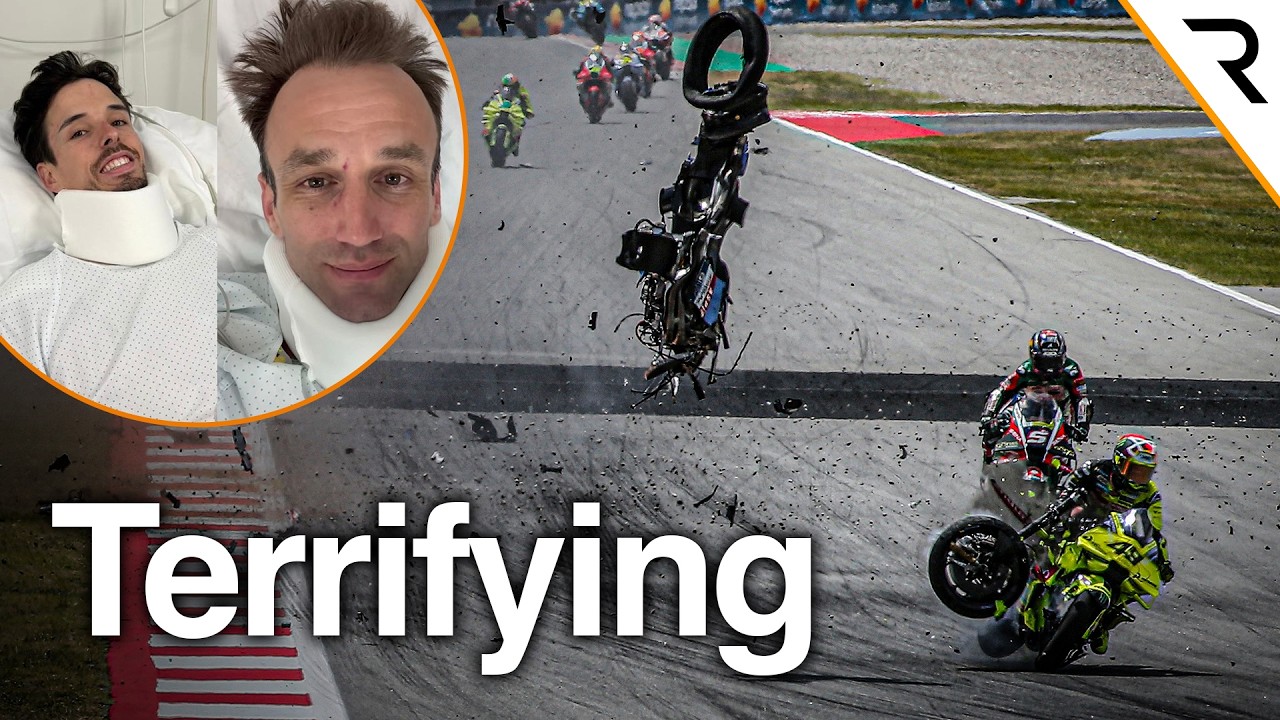
The 2026 Catalan Grand Prix delivered two red flags, two riders in hospital and a slew of cold-tyre highsides that have left MotoGP's most influential podcasters openly questioning whether the championship is doing enough to manage avoidable risk.
Speaking on The Race MotoGP podcast, host Matt Beer, Simon Patterson and Valentin Khorounzhiy waited until late on Sunday night to record their reaction in order to confirm that Johann Zarco and Alex Marquez had escaped without the worst-case scenarios their crashes had threatened. The mood, even with that reassurance, was bleak.
"I'm exhausted tonight. I can't believe we have to go testing tomorrow," Patterson said. "The last Sunday night I remember feeling like this was Austria 2020 for exactly the same reasons — that kind of empty, drained, oh my god, I can't believe we got away with it feeling."
Patterson argued that the warning signs had been flashing since Friday morning, with bikes folding under their riders and bouncing back into the racing line at a circuit where MotoGP's most recent fatality, Luis Salom, was lost in eerily similar circumstances in 2016.
"Right from Friday, I was feeling like we were seeing multiple crashes at Barcelona where bikes were going into the wall, taking the rider with them, bouncing back out," Patterson said. "I think in our work chat it was [Khorounzhiy] who just said, 'I really don't want to be doing this again.' And we got to red flag number two, restart number two."
Khorounzhiy was equally subdued, framing motorsport's risk acceptance as a "Faustian bargain" that demands the sport at least make the danger feel necessary rather than gratuitous.
"It's never a feeling you want to have," he said. "It is an activity that leads to danger that you could potentially describe as needless very, very easily. And the least they can do generally is to make it feel like the needlessness of the danger is minimised."
Two issues dominated the post-mortem. The first was Montmelo's chronic grip problem, which Patterson said riders described in unison as feeling "like you're on ice." That has been the case for years, but Toprak Razgatlioglu — fresh out of Pirelli-shod World Superbikes — provided the punchline, returning to his garage on Friday and asking his mechanics whether the bike was broken.
The second issue was tyre allocation. Catalan temperatures collapsed below the seasonal norms used to set Michelin's tyre choice months in advance, and the consequences played out in slow motion across every session. The Race team singled out Marc Marquez's Friday highside, in which he followed his own RC213V into the barriers, as the curtain-raiser for what was to come. Pol Espargaro then explained that a three-to-four second slower lap during the race had been enough to switch his rear tyre off entirely — a drop-off Patterson described as nowhere near significant enough to justify the consequences.
"We have this stupid thing where we set our tyre allocation months in advance," Patterson said. "So it's not a tyre allocation designed for cold Barcelona. It's an entire allocation designed for warm Barcelona."
Patterson, Beer and Khorounzhiy stopped short of demanding a single fix, but the questions they raised will not go away before MotoGP reconvenes. Race direction is being asked why a venue with a track record of cold-tyre highsides keeps a fixed allocation; whether Barcelona's resurfacing or top-coat treatment needs to be revisited; and why the restart procedure on Sunday produced a second pile-up rather than averting one. Italian pole man Pedro Acosta and race winner Fabio Di Giannantonio had both signalled before lights out that something was not right with the grip.

The Race members' inboxes told the same story. As Beer summarised: "What the hell was that?" — a comment that, in his words, captured the prevailing mood of an audience usually willing to accept the risks of two-wheel grand prix racing without comment.
---