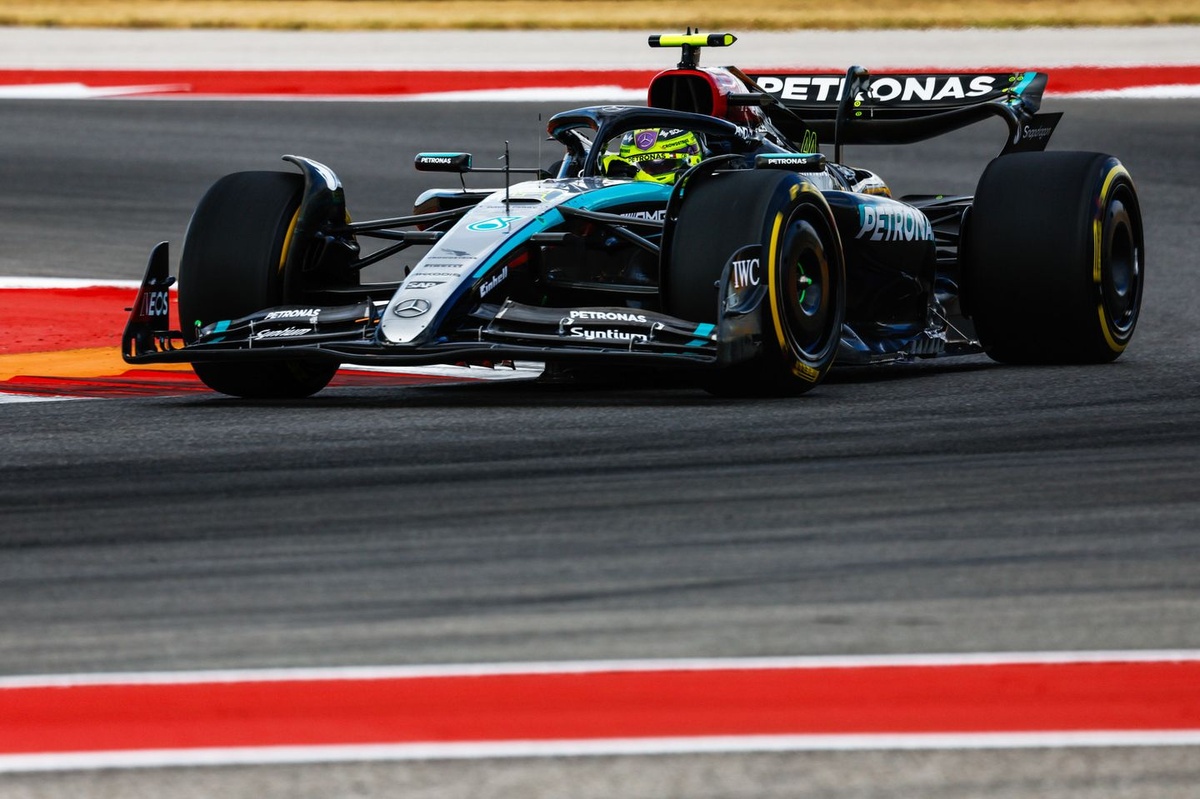
The atmosphere in Austin was buoyed by Mercedes' recent upgrades, which seemed to have made a significant impact at the United States Grand Prix. Following a series of disappointing performances since the summer break, the front-row start by George Russell in the sprint race rekindled optimism within the team.
"After a disappointing time since the summer break, George Russell’s front-row start for the United States GP sprint race has lifted hopes that a new upgrade package has hit the spot," said a team spokesperson, reflecting the renewed anticipation surrounding the W15 model.
"After a disappointing time since the summer break, George Russell’s front-row start for the United States GP sprint race has lifted hopes that a new upgrade package has hit the spot,"
The changes implemented by Mercedes were both extensive and meticulously designed, extending from the front wing all the way down the length of the car. A new spanwise flap distribution was introduced to alter the performance dynamics between outwash and downforce generation, a crucial aspect in optimizing car performance at high speeds.
.webp)
In addition, alterations to the upper wishbone fairing were aimed at further enhancing the vehicle's aerodynamic properties. Andrew Shovlin, the trackside engineering director for Mercedes, discussed these changes, emphasizing their evolutionary nature. "I mean, it's not a sort of fundamentally different concept. It’s an evolution of that floor from Spa. It’s not the only change on the car but hopefully it'll be a big enough step forward to help us," Shovlin explained.
Team Dynamics

The Mercedes team also worked on their sidepod design, switching to an overbite solution while adjusting the P-shaped inlet. This construction was specifically tuned to improve airflow performance around the sidepod, particularly concerning the undercut—an area that plays a vital role in cornering efficiency.
As for the edge wing, it received its own set of modifications. Now featuring six strakes instead of the previous five, these adjustments are intended to maximize airflow, especially at high speeds. One of the newly added strakes has a distinctive hook shape, curving under itself, enhancing its ability to collect and roll up airflow to improve overall downforce.
Cooling capabilities also benefited from this upgrade, with added outlets now strategically placed around the forward leg of the upper wishbone to enhance thermal management during races.

"The latest addition, which is mounted at the front of the edge wing, has more of a hook appearance, folding round and back under itself to help collect and roll up the airflow," noted a technical engineer involved in the upgrade process.
"The latest addition, which is mounted at the front of the edge wing, has more of a hook appearance, folding round and back under itself to help collect and roll up the airflow,"
This cohesive integration of modifications has promised to deliver improved performance during not only the US GP but also the upcoming races. As teams prepare for a more competitive season finale, Russell's performance has provided a boost in morale for Mercedes.
Team Dynamics
In the broader context of the F1 season, the instant success of these upgrades at the United States Grand Prix will be pivotal for Mercedes as they navigate through the final races of the year. The team aims to leverage this competitive advantage while analyzing further enhancements for their car, signaling a strategic pivot designed to elevate their performance under pressure. With less than a handful of races left, the eyes of the F1 world will be on Mercedes to see if they can sustain this momentum.