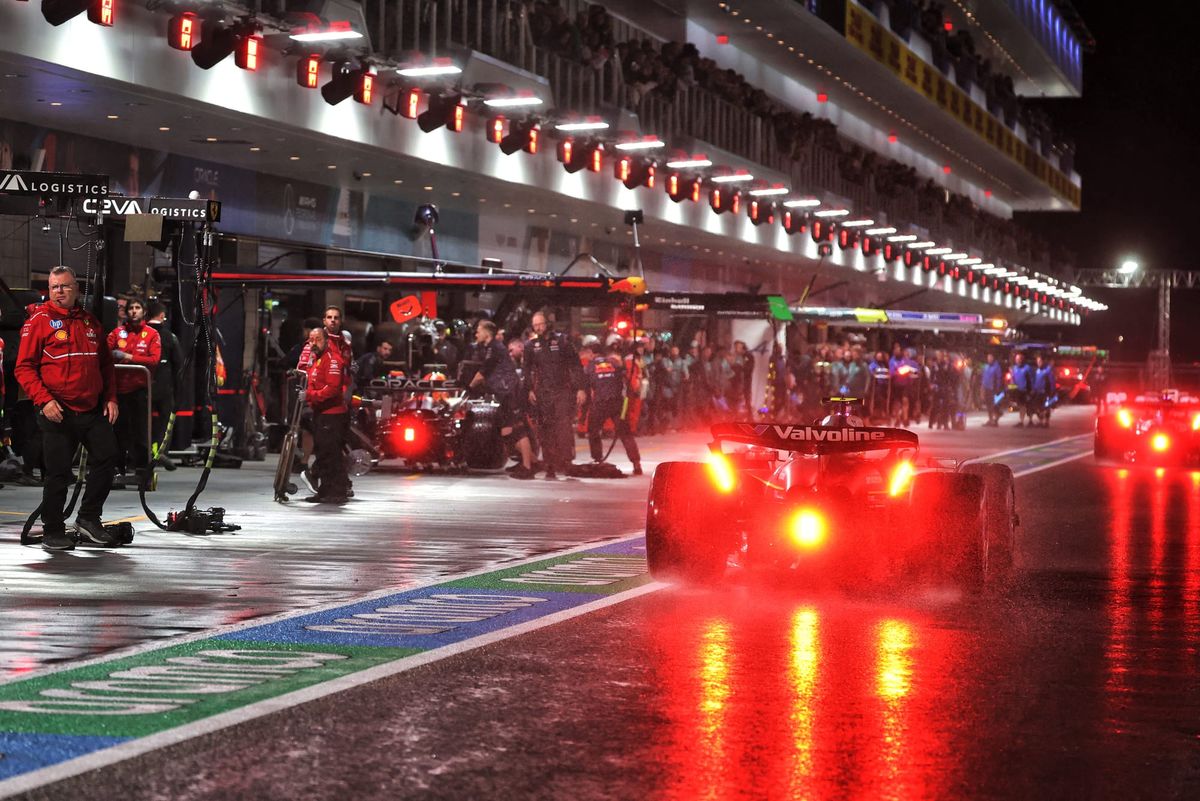
Formula 1’s new Rain Hazard protocol has been invoked for the first time at the Miami Grand Prix, ahead of Sunday’s race. The FIA issued the following notice: "Having received a forecast from the Official Weather Service predicting that the probability of precipitation will be greater than 40% at some time during the race at this competition, a Rain Hazard is declared," said an FIA message.
Under the sporting rules, a Rain Hazard can be declared if the official weather service predicts a precipitation probability above 40% at any point during a sprint or the race, or at the race director’s discretion. It must be confirmed no later than two hours before sprint qualifying at a sprint event or before main qualifying for the grand prix. Beyond those core criteria, many of the operational specifics are set out in guidance circulated between the FIA and teams rather than in the public rulebook.
If a Rain Hazard is called while cars are in parc ferme, teams are permitted to undertake work described in an FIA document (FIA-F1-DOC080). This does not amount to a wholesale release of parc ferme. The intent is not to let competitors re-optimise their cars for changing conditions after qualifying.

Historically, variable weather has forced teams to commit to either dry or wet set-ups before qualifying, often risking being stuck with the wrong compromise for the race. Parc ferme has long meant that significant changes after qualifying would require a pitlane start. The Rain Hazard does not overturn that philosophy.
Instead, the measure addresses a 2026-specific complication: active aerodynamics and the risk of excessive plank wear. In straight mode, the new-generation cars reduce downforce, and ride heights are chosen with that in mind. If straight mode is disabled for safety or wet-weather reasons and the front wing remains in high-downforce corner mode at high speed, the car can run too low and abrade the plank, potentially leading to exclusion.
To mitigate that, F1 introduced a partial aero option that, in designated sections, allows the front wing to open while the rear wing stays closed. This lifts the front of the car and eases loading on the plank. However, not every straight-mode zone includes such allowances, so certain high-speed runs can still pose a wear risk when conditions change unexpectedly.
The Rain Hazard creates a narrow window for protective changes when teams have committed to a dry baseline but rain becomes likely. Two elements can be altered: teams may revise the active front aero settings across their two states, and they may increase ride height to safeguard the plank. These adjustments are framed as legality and durability measures rather than performance resets.

The approach aims to reduce unintended penalties without unpicking parc ferme’s core purpose. It preserves the commitment made in qualifying while preventing a weather swing from forcing cars into non-compliance through no fault of intent.
The current framework is expected to be evaluated over the first nine races to ensure it works as intended. From the Austrian Grand Prix at the end of June, the FIA will either keep the system as is or consider a simpler alternative, potentially allowing teams to switch between defined dry and wet settings depending on conditions.
---

*Originally published on [News Formula One](https://newsformula.one/article/f1-invokes-new-rain-hazard-rule-for-miami-grand-prix). Visit for full coverage.*